Establishing Durable Paths with Decomposed Granite
A well-designed path unifies landscape elements while providing practical access. Decomposed granite offers an effective solution for surfaces that require visual harmony, superior drainage, and minimal ongoing effort. Homeowners frequently select it for walkways, patios, and driveways due to its versatile texture that complements diverse yard aesthetics. Grasping its composition, application methods, and care routines enables informed decisions for optimal landscape enhancement.
Understanding Decomposed Granite
Decomposed granite, commonly abbreviated as DG, results from the natural breakdown of granite rock into granular particles and fine powder. This material resembles gravel in appearance yet provides a softer, more stable feel. Colors typically span tan to gray, with variations influenced by regional geology. Available in three primary categories, each serves distinct applications:
- Loose DG: Sourced directly from quarries without additives, this form delivers a rugged, organic appearance and rapid water infiltration.
- Stabilized DG: Incorporated with binding agents, it enhances cohesion to minimize erosion and airborne particles compared to loose variants.
- Resin-coated DG: Infused with resin for a solid, pavement-resembling finish, this option maximizes longevity at an elevated cost.
Selection depends on usage intensity. Loose DG suits casual garden trails emphasizing natural aesthetics. Stabilized DG proves suitable for high-traffic walkways and patios. Resin-coated DG excels in vehicular areas or public installations demanding unyielding stability.
Key Advantages for Homeowners
Decomposed granite distinguishes itself through the integration of aesthetic appeal and practical efficiency. Consider these primary benefits:
- Versatile shaping: Form curves, linear segments, or subtle inclines using basic tools like rakes and shovels.
- Effective drainage: Permeable structure allows rainwater to percolate, preventing accumulation and related issues.
- Affordable pricing: Loose and stabilized forms range from one to three dollars per square foot, undercutting concrete or paver expenses.
- Seamless integration: Fine grain size fosters a cohesive blend with surrounding vegetation and terrain.
- User-friendly texture: Compacted surface yields firmness without the abrasiveness of coarser aggregates, enhancing comfort for pedestrian routes.
Professional installation incurs an additional two to four dollars per square foot. Such economics position DG as a cost-effective hardscape choice for expansive projects.
Site Preparation Essentials
Thorough groundwork ensures the longevity of decomposed granite installations. Begin by delineating the path using stakes and taut string lines to define boundaries precisely. Excavate to remove sod, vegetation, and the uppermost four inches of soil, targeting a finished depth of three inches for pedestrian areas or six inches for vehicular support.
Compact the subsoil to establish a firm base, then install geotextile fabric to suppress weed intrusion. Layer two inches of angular crushed stone or coarse gravel for foundational drainage and to prevent subsidence. Achieve uniform compaction with a plate compactor or hand tamper before applying DG.
Distribute DG in one-inch increments, moistening each layer lightly and compacting thoroughly to promote adhesion. Three such layers typically yield a level, resilient surface. Adhere to manufacturer guidelines for stabilized or resin-coated products, maintaining optimal hydration to activate binders effectively.
Ongoing Maintenance Practices
Decomposed granite surfaces demand less intervention than rigid pavements, yet periodic checks preserve their condition. Loose DG may experience minor displacement following intense precipitation; redistribute material with a broom and rehydrate to restore uniformity. Stabilized or resin-coated versions permit spot repairs by integrating fresh DG into affected zones and recompacting.
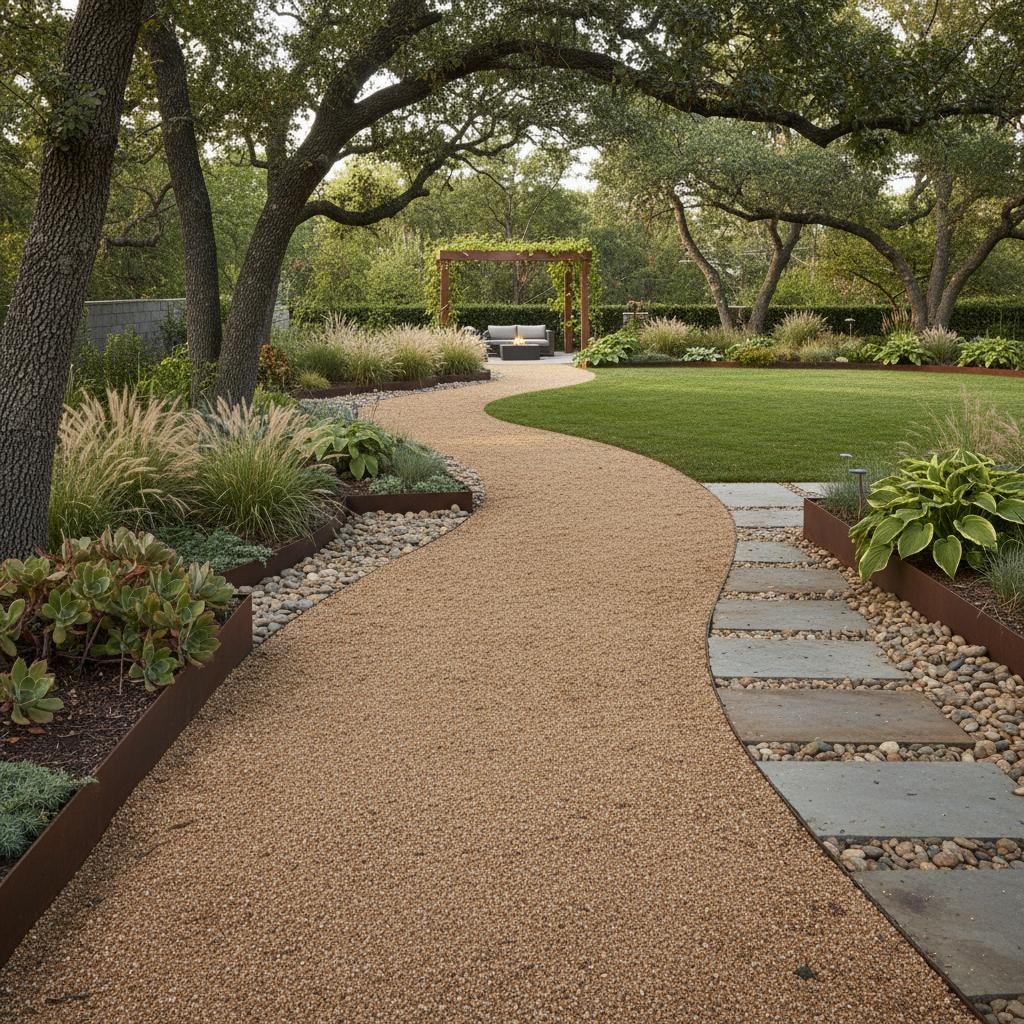
Edge-adjacent weeds require prompt removal via manual extraction or diluted vinegar application. In regions prone to heavy downpours, install metal, brick, or stone borders to retain material and avert erosion. These measures maintain crisp edges and structural integrity.
Replenish the surface every two to three years with minimal quantities, such as one or two cubic yards for a standard walkway. Gradual color softening through exposure often enhances the material's rustic character rather than detracting from it.
Decomposed Granite Versus Alternative Materials
Path material selection hinges on fiscal, visual, and durability considerations. Decomposed granite compares favorably to prevalent alternatives as follows:
- Traditional gravel: Matches in affordability but delivers a coarser, less cohesive tread; DG compacts for refined stability.
- Interlocking pavers: Convey formality and resilience, yet demand two to three times the investment alongside meticulous layout.
- Poured concrete: Provides uniformity and strength, but at higher costs and vulnerability to thermal fractures; DG ensures better hydrology and gentler aesthetics.
- Organic mulches: Install swiftly and inexpensively, though they decompose, necessitating frequent replacement; DG endures seasons without dispersal.
Positioned between informal aggregates and structured elements, DG balances formality with organic flow.
Ideal Applications for Decomposed Granite
This material adapts to myriad outdoor contexts favoring permeable, naturalistic flooring. Proven settings encompass:
- Curving garden trails
- Expansive patio bases
- Light-duty driveway approaches
- Fire pit surrounds
- Connectors for elevated planters
- Lawn or perennial borders
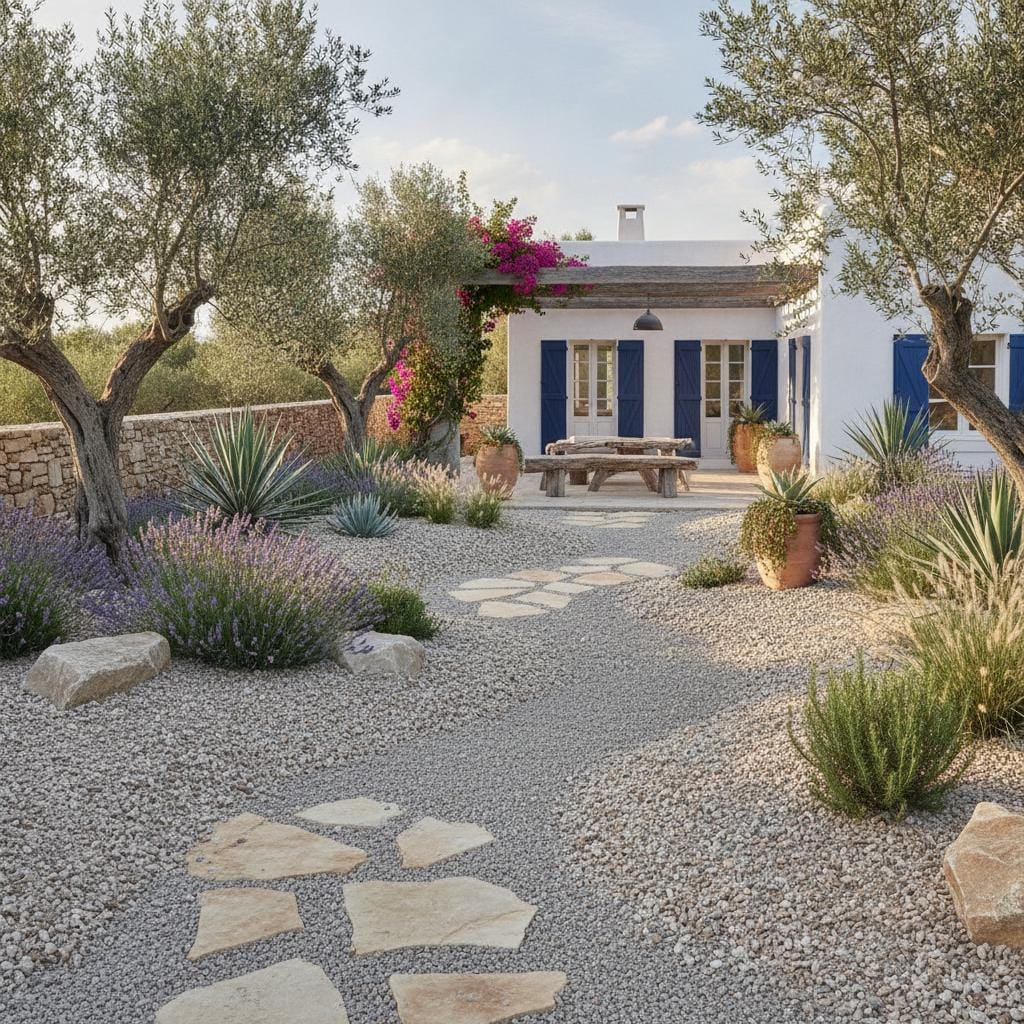
It harmonizes with varied design paradigms. Within informal cottage layouts, DG merges with flora and boulders. In contemporary minimalism, it introduces subtle texture and warmth without overpowering simplicity. Its permeability benefits low-lying or moisture-retentive zones, mitigating flood risks associated with impervious covers.
Pitfalls to Sidestep in Installation
Certain oversights compromise decomposed granite performance. Steer clear of these errors:
- Omitting sub-base: Absence of underlying crushed aggregate leads to irregular settling and instability.
- Neglecting gradient: Level profiles invite water retention and degradation; incorporate a one to two percent slope directing runoff from structures.
- Excessive hydration: Over-saturation during layering disrupts binder distribution, yielding clumpy inconsistencies.
- Inappropriate variant selection: Loose DG falters under vehicular loads; opt for stabilized or resin-coated reinforcements in demanding locales.
- Forgoing containment: Unbordered edges permit lateral migration, blurring path definitions.
Addressing these factors secures a pathway resilient to environmental stresses over extended periods.
Executing Your Decomposed Granite Project
Most homeowners manage decomposed granite installation with fundamental tools and moderate labor. A modest trail completes over a weekend, involving excavation, basing, and layering. Complex configurations or expansive areas benefit from expert involvement to guarantee precise elevation and densification.
Commence with accurate measurements and material volume computations, procuring ten percent surplus for contingencies. Select borders, DG category, and hues from regional vendors. Post-installation, routine sweeping and infrequent additions suffice to sustain vibrancy.
Decomposed granite yields pathways that fuse functionality with landscape cohesion, offering enduring access that withstands elemental variations while inviting barefoot traversal.